The Social Sciences are in a constant struggle to improve their methodologies and levels of accuracy.
Opinion polls have recently proven to be unreliable predictors of seismic political change. Brexit and the Trump presidential win both surprised the polling industries and political classes alike.
 The global financial crisis of 2008 was not widely anticipated by economists.
These areas of study will never be an exact science but is science an exact science?
Peter Medewar was a British Nobel prize winning biologist whose work on immunology helped pave the way for organ transplants. He also had an interest in the philosophy of science and in 1967 published The Art of the Soluble.
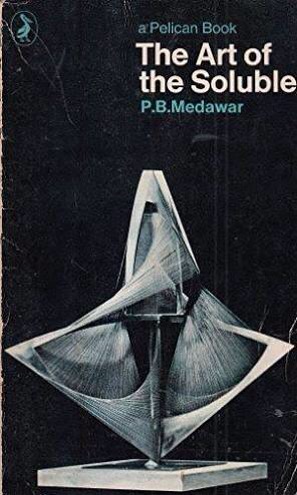 In this book he examines the nature of science and the processes of the scientist. For anyone interested in science or social science it is a hard book to get hold of as it is out of print, but it is a useful read.
If politics is the art of the possible, research is surely the art of the soluble. Both are immensely practical-minded affairs.
Medewar makes the point that science is not just data collection and analysis, nor is it just testing hypotheses. Science is also about imagination and creativity.
Scientists should not be ashamed to admit, as many of them apparently are ashamed to admit, that hypotheses appear in their minds along uncharted by-ways of thought; that they are imaginative and inspirational in character; that they are indeed adventures of the mind.
It is about conjecture and there are many different approaches to science outside of the narrow scope of testing for false hypotheses.
There is no such thing as a Scientific Mind. Scientists are people of very dissimilar temperaments doing different things in very different ways. Among scientists are collectors, classifiers, and compulsive tidiers-up; many are detectives by temperament and many are explorers; some are artists and others artisans. There are poet-scientists and philosopher-scientists
It is also about timing. Is the time right for something to be solved. Is the difficulty and pay off for solving a problem aligned. The Medewar Zone, named after him, conceptually maps out the goldlilocks zone of scientific research.
No scientist is admired for failing in the attempt to solve problems that lie beyond his competence. … Good scientists study the most important problems they think they can solve. It is, after all, their professional business to solve problems, not merely to grapple with them.
 To go back to the examples of political polling and economics, are these practices that can become truly scientific? A better question is – What is the effect of attempting to turn them into science?
Human behavior is much more unpredictable than the laws of physics. Economics only works in so far as past behavior is an accurate guide to future behavior. Believing that economics has become scientific, however, becomes a blocker to any significant realignment of it as a discipline and disguises current orthodoxy as an unalterable fact.
Rethinking economics after the global financial crisis– The Guardian
Political polling, when viewed as scientific, pushes politicians towards policy as electoral tactics rather than a representation of their ethics and principles.
Creating the appearance of science without a full appreciation of the way science actually works is counter productive. The result is that mainstream politics is no longer the art of the possible. Less creative than the science it tries to emulate, it shrinks back to a data gathering and analysis approach to life. An approach Medewar criticized as a misunderstanding of how science works.
Scientists who think science consists of unprejudiced data-gathering without speculation are merely cows grazing on the pasture of knowledge
And, of course, when the voting public gets fed up being told that the current reality is inevitable and unalterable, they will occasionally turn to those who are unconcerned by convention.
 William F Cooper